
Most buyers think negotiation means one thing: price. They’re wrong. Good negotiating tips for buying a house start with price, but the deal is usually won or lost on terms, conditions, timing, and whether the paperwork matches what everyone thinks was agreed.
Negotiating tips for buying a house: what matters most before you make an offer
The best way to negotiate a house purchase is to prepare your evidence before you speak and your terms before you sign. In Ontario, the Agreement of Purchase and Sale is not a casual summary. It is the deal document that controls price, deposit, inclusions, closing date, conditions, and what happens if something was left vague.
The strongest house offer negotiation tips are simple. Know your ceiling. Know your walk-away number. Know your comparables. Decide which conditions protect you. Decide which terms make your offer cleaner without making it riskier.
A buyer with a lower price but cleaner terms can beat a higher messy offer. We see that in GTA deals every year. Sellers care about certainty, timing, deposit delivery, and whether the buyer looks ready to close.
A quick shortlist helps:
- set your maximum budget before touring seriously
- review sold comparables, not just asking prices
- match your offer strategy to the market, not your emotions
- negotiate terms beyond price when the seller values certainty
- use inspection findings narrowly and credibly
- do not waive financing, inspection, appraisal, or condo review casually
- have a lawyer review unusual terms before they become a closing problem
Step 1: Know your maximum budget and your walk-away number

Your lender’s approval amount is not your comfort limit, and neither one is your walk-away number. Affordability in Canada turns on income, debts, down payment, interest rate, property taxes, heating costs, condo fees if any, and the lender’s underwriting rules, not one universal salary figure for a $1,000,000 mortgage.
The cleaner way to set an offer number is to start with your monthly carrying comfort and work backward. Then add the cash you will still need for closing costs, moving, immediate repairs, utility setup, and basic furnishings if the home needs them. Land transfer tax, legal fees, title insurance, and statement of adjustments items are real closing costs, not side notes.
A simple worksheet is usually enough:
- top purchase price you can finance comfortably
- cash available for down payment and deposit
- cash left for closing costs and adjustments
- likely repair or upgrade budget in the first 30–90 days
- hard walk-away number if bidding moves too far
Emotion pushes buyers past their own math. A walk-away number stops that. If the counteroffer crosses that line, the right move is often to stop, not stretch.
Step 2: Read the market before you decide how aggressive to be

There is no universal answer to how much is reasonable to negotiate on a house. The real answer depends on the property’s pricing strategy, local demand, property type, condition, inventory, competing offers, and whether the list price was set to attract bidding or to test a high number.
Your leverage is strongest when a listing looks stale, has repeated price cuts, came back to market after a failed deal, shows deferred maintenance, or has an awkward closing timeline. Your leverage is weakest when the property is newly listed, well priced against recent sold comparables, and drawing multiple serious buyers.
In a buyer’s market, price and conditions usually do more work for you. In a seller’s market, certainty often matters more than squeezing every dollar. In a balanced market, negotiation is usually a blend of both. Those are market concepts, not legal rules.
Toronto and GTA buyers should pay attention to relisting patterns. A property that was listed, terminated, and relisted at a different price can signal either strategic marketing or a failed expectation. The listing history does not prove weakness by itself, but it gives context for your approach.
Step 3: Use comparable sales to justify your offer

The best support for a lower offer is sold data from similar homes, not your opinion that the property feels overpriced. Good comparables are nearby, recent, and similar in type, size, condition, lot, parking, layout, renovation level, and school or neighbourhood context.
Sold prices matter more than asking prices because list prices are strategy. One seller lists low to create competition. Another lists high to test the market. Neither list price tells you what buyers actually paid.
A simple comp analysis is usually enough to negotiate down an overpriced house. If a similar detached home sold with an updated kitchen, finished basement, and better parking, a weaker subject property should not command the same number. If your target property also has an aging roof or a dated electrical panel, your price logic gets stronger.
A respectful evidence-based message works better than a low number with no explanation. Sample wording: “Based on recent sold comparables in the area, and accounting for the home’s current condition and updates required, our offer reflects market value as we see it today.” That keeps the discussion on evidence, not ego.
When the list price is clearly disconnected from recent sales, say less and show more. Three relevant sold examples usually carry more weight than a long argument. A seller may reject you anyway, but your position stays credible for a later return if the listing sits.
Step 4: Spot seller motivation ethically

Seller motivation is real leverage, but it should be read from proper signals, not private digging. Ethical clues include long days on market, vacancy, repeated price reductions, an obvious repair backlog, a relisting history, or a closing date that appears unusually tight or unusually far away.
Some properties are harder to finance, insure, or resell, and that can affect negotiation room. Poor condition, awkward layout, location drawbacks, tenant complications, major deferred maintenance, or condo concerns can all reduce demand. “What devalues a house the most” has no single legal answer, but persistent location and condition problems usually matter more than cosmetic style choices.
Motivation should change what you ask for. A seller who needs a fast clean closing may care more about certainty and date than squeezing out the last increment of price. A seller with no urgency may ignore a low offer but respond to better terms and cleaner paperwork.
We would not tell buyers to investigate personal circumstances beyond what is properly disclosed or publicly apparent. Focus on the property, the listing history, and the deal terms you can document.
Step 5: Decide what to negotiate besides price
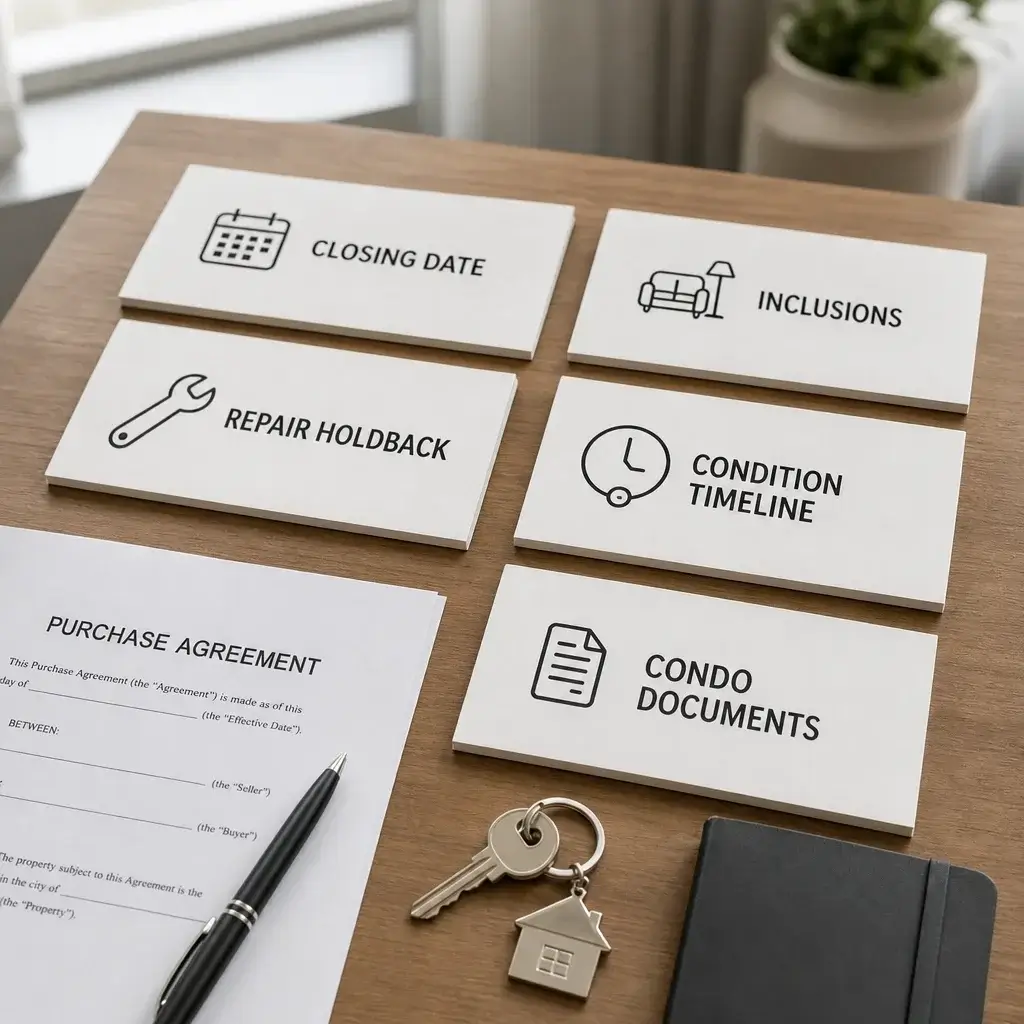
Price is only one lever. Buyers can often negotiate deposit timing, closing date, inclusions, exclusions, appliances, window coverings, light fixtures, repair holdbacks, access for trades, and condition timelines if the seller will agree.
Closing costs themselves are usually each side’s own responsibility in Ontario, but the economics can still shift. A seller may agree to a lower price, a repair before closing, a credit through an adjustment if properly documented, or a better inclusion package instead of moving much on headline price. We would need the agreement and lender instructions to say for sure how a specific credit should be structured.
Closing date is a bigger bargaining chip than buyers expect. A flexible possession date can matter as much as a small price change when the seller is coordinating another purchase, a tenant move-out, or estate timing. On the buyer side, a rushed closing can create lender and document stress if mortgage instructions arrive only a few days before completion.
Inclusions need exact wording. “Appliances included” is weaker than listing the fridge, stove, dishwasher, washer, dryer, and any specific built-ins. Fixtures usually stay with the property. Chattels usually do not unless listed. That distinction causes avoidable fights.
Condo buyers have extra points to negotiate. Status certificate review, pending special assessments, shared facility costs, parking or locker rights, and what the seller must deliver on closing can all affect value and risk. A condo deal that looks cheap can become expensive if the documents show upcoming costs.
What buyers can negotiate besides price
| Item | When it matters most | Who should review it |
|---|---|---|
| Closing date | Seller needs timing certainty or buyer needs lender time | Agent, lender, lawyer |
| Inclusions and exclusions | Appliances, fixtures, custom items, rentals | Agent, lawyer |
| Repair issue or holdback | Defect found before firming up or before closing | Lawyer |
| Condition timelines | Financing, inspection, appraisal, condo review | Agent, lender, lawyer |
| Access before closing | Measurements, contractor visit, condo move planning | Lawyer |
| Condo document obligations | Status certificate, parking, locker, special assessment context | Lawyer |
Step 6: Choose the right conditions and understand the risk of waiving them

Conditions protect your ability to investigate, finance, and close. The main ones buyers ask about are financing, inspection, appraisal, status certificate review for condos, and sometimes sale-of-property conditions if another home must sell first.
A financing condition protects you if the lender will not approve the property or the loan on acceptable terms. An appraisal condition protects you if the lender’s value comes in below the purchase price. An inspection condition gives you a chance to assess the home’s physical condition. A status certificate review condition lets a condo buyer check the corporation’s financial and legal picture before the deal becomes firm.
Waiving conditions can make an offer more attractive, but it increases risk immediately. If you waive financing and your lender later declines the file, the seller may claim your deposit and pursue damages. If you waive inspection and later discover a major issue, the problem is usually yours.
There is no honest rule that says always waive or never waive. The right answer depends on the property’s risk, your financing strength, the completeness of available information, the market pressure, and whether you can complete your review before the offer goes in. Unique homes, older houses, condos with sparse disclosure, builder contracts, power of sale files, and tenanted properties usually need more caution.
Common conditions in plain English
| Condition | What it protects | Main downside in negotiation | When legal review helps most |
|---|---|---|---|
| Financing condition | Your ability to get approved mortgage funds | Seller may prefer cleaner competing offer | Tight timelines, unusual lender terms |
| Inspection condition | Physical condition and hidden defects | Seller may resist in hot markets | Older homes, visible defects, rural features |
| Appraisal condition | Low lender valuation risk | Adds uncertainty for seller | High-price or rapidly rising markets |
| Status certificate review | Condo finances, bylaws, lawsuits, assessments | Slows firm deal by a few days | Any condo purchase |
| Sale-of-property condition | Ability to sell your existing home first | Often weakens offer materially | Chain transactions and timing risk |
Step 7: How to negotiate after the home inspection

Inspection findings help most when you separate material issues from cosmetic ones. A long wish list about paint, caulking, or ordinary wear usually weakens your position. A short focused request tied to safety, water entry, structure, roofing, electrical, plumbing, HVAC, or insurer and lender concerns carries more weight.
The practical workflow is straightforward. Get the report. Sort defects into major, moderate, and minor. Obtain repair estimates where reasonably possible. Decide whether the right remedy is price reduction, repair, credit, or walking away. Then put the amendment in writing through the proper channels. Side promises are not enough.
A price reduction makes the most sense when the defect affects broad value. A measurable adjustment or credit can work when the cost is clearer and both sides want to keep the deal together. A repair request makes more sense when safety, timing, insurability, or lender requirements matter more than cash. We would need the wording and closing structure to say how any credit should be documented.
A reasonable request sounds like this: “Based on the inspection findings regarding the roof and active plumbing leak, the buyer is prepared to proceed if the purchase price is adjusted to reflect the documented repair issues, or if the parties agree on a written amendment addressing them before the condition deadline.” That stays narrow and commercial.
One avoidable mistake is leaving the amendment vague. If the seller will repair, the agreement should say what work, by whom, and by when. If the seller will credit an amount, the amendment should say how the adjustment is handled on closing.
Step 8: Handle appraisal gaps, financing issues, and lender concerns

An appraisal gap means the lender values the property below your purchase price, leaving you to bridge the difference, renegotiate, or rely on a protective condition if you still have one. In plain terms, the bank does not always fund your agreed price just because you agreed to it.
Pre-approval helps in house-price negotiation because it shows readiness, but it is not final approval. Lenders still review the property, your documents, your debt load, employment, down payment source, and sometimes condo or title details before issuing final instructions.
If the appraisal is low, your usual choices are limited but clear. Challenge the valuation with better comparables. Increase your down payment. Ask the seller to reduce the price. Or walk away if a financing or appraisal condition still protects you. The right move depends on cash available and whether the home still makes sense at the revised economics.
Strong buyer files negotiate better because sellers trust them more. Full income documents, clear deposit funds, stable employment, and early lender communication reduce the risk of last-minute trouble. On closing files, 9 times out of 10 payout or instruction delays are administrative rather than dramatic, but they still hurt buyers who left no room in the timeline.
Step 9: Strategies for multiple offers, bully offers, and seller-leaning markets

In multiple offers, your goal is to remove weak points without removing essential protection blindly. Price matters, but clarity, clean drafting, deposit readiness, flexible closing, and a well-supported offer often matter too.
A bully offer is generally an aggressive pre-set date offer intended to force an early seller decision before the scheduled offer date. An escalation clause is generally wording that attempts to increase your offer automatically against competing bids up to a cap. Local practice, seller instructions, and brokerage handling all matter here, and we would want the actual clause reviewed before anyone relies on it.
In a seller’s market, the best way to negotiate without paying more is to improve certainty. Shorten avoidable response delays. Deliver documents cleanly. Make the closing date work for the seller if it still works for you. Be precise about inclusions. Show deposit readiness. Those steps can move a seller without changing your number.
What you should not sacrifice just to win is equally important. Do not blow past affordability. Do not leave unusual legal terms unread. Do not ignore condo documents. Do not accept a closing date your lender cannot realistically support. The house is not won if the closing later fails.
Step 10: Sample scripts for offers, counters, and respectful pushback

A below-ask offer works best when it is short, evidence-based, and calm. Sample: “We are pleased to submit an offer based on recent comparable sales and the updates the home still requires. We believe the enclosed price reflects current market value and we are in a position to move forward on the timeline set out in the agreement.”
An inspection-based counter should focus on the key defects only. Sample: “Following the home inspection, the buyer remains interested in proceeding. Given the material findings relating to moisture intrusion and the furnace condition, the buyer requests an amendment adjusting the purchase price, failing which the buyer reserves rights under the inspection condition.”
A response to a seller counter should trade, not just refuse. Sample: “We cannot move further on price, but we can strengthen the offer by confirming a faster condition process and accommodating the requested closing date, provided the listed inclusions remain part of the agreement.”
An overpriced listing needs a different tone. Sample: “We recognize the seller’s asking price, but our offer is based on the most relevant sold comparables available and the home’s present condition. If circumstances change, we would be pleased to revisit the discussion.” That leaves the door open.
A competitive listing with little room on price needs a certainty script. Sample: “Our offer is near the top of our budget, so we are focusing on clean terms, a workable deposit, and a closing date aligned with the seller’s needs.” Final legal wording still belongs in the formal agreement and any signed amendments, not in text messages alone.
Common negotiation mistakes buyers make
The most common mistake is treating negotiation like a contest instead of a risk decision. Buyers overbid emotionally, insult sellers with unsupported low offers, focus only on headline price, ignore closing costs, and agree to terms they cannot actually support.
Another common mistake is relying on verbal promises. If the seller says an appliance stays, a repair will be done, or early access is allowed, that point should be written into the agreement or a proper amendment. If it is not written, enforcing it later gets harder fast.
Buyers also copy generic internet rules as if they were Ontario real-estate law. The 70/30 rule, 5 C’s of negotiation, 20/30/3 rule, 4 golden rules, and 65/85/95/100 rule are broad frameworks at best. They are not house-purchase rules in Canada, and they do not replace comparables, budget discipline, financing reality, and careful contract review.
One more mistake deserves blunt treatment: copying U.S. or Reddit advice into an Ontario deal. Resale homes in Ontario do not have a broad cooling-off right just because a buyer feels unsure later. Once conditions are waived or fulfilled and the agreement is firm, the legal and financial consequences are real.
Ontario-specific legal and closing points buyers should not ignore
A real estate lawyer’s role in a purchase starts before closing if the deal has unusual terms. We review the agreement language, amendments, title issues, condo document concerns, adjustment risks, and fraud-prevention points that can become expensive later.
Negotiation choices carry forward into closing work. A changed closing date affects lender timing. A vague inclusion can become a possession dispute. A poorly drafted repair promise creates enforcement trouble. A credit can clash with lender requirements if the wording is wrong. A condo issue found in the status certificate can change whether the buyer should proceed at all.
Title review still matters even when the negotiation seemed straightforward. We search title, review registered interests, check for items that must be discharged, and requisition issues that need correction before funds are released. Buyers usually care about the new kitchen; on closing day, unpaid liens, missing discharges, and late mortgage instructions matter more.
A lawyer is especially useful early when the file involves a private sale, estate sale, power of sale, tenancy, unusual deposit wording, builder paperwork, condo complications, title transfer overlap, or a refinance that must close around the same time. Tenanted and commercial files are quoted separately.
If you are already under contract, earlier is still better than later for the legal side. We can often spot wording that may affect closing, but we cannot rewrite a firm deal after the fact just because the business terms now look unwise. Remote signing is common on Ontario residential files, and it helps when timelines are short.
Pre-offer checklist for buyers
A checklist before making an offer on a house should be practical, not decorative. If these points are not settled, your negotiation usually gets weaker.
- mortgage pre-approval in hand and documents updated
- maximum budget set below your panic number
- walk-away number written down
- deposit funds available and traceable
- sold comparables reviewed for the area
- rough closing-cost plan prepared
- must-have inclusions and exclusions listed
- preferred closing date and backup date chosen
- condition strategy decided: financing, inspection, appraisal, condo review
- inspection plan ready if the property warrants one
- condo status review plan ready if buying a condo
- lawyer contact ready for unusual terms or agreement review
- repair and upgrade budget reserved for the first 30–90 days
If you already signed an offer, a lawyer can still help with next steps before closing. Earlier is better when the agreement has unusual terms, but later review is still better than no review.
FAQ: quick answers to common home-buying negotiation questions
How much is reasonable to negotiate on a house?
There is no fixed percentage rule. A reasonable negotiation depends on sold comparables, condition, days on market, pricing strategy, and whether there are competing offers.
How low should my first offer be on a house?
Low enough to leave room to move, but not so low that you lose credibility. In a balanced or slower market, buyers often start below target value; in a hot market, a weak first offer may simply be ignored.
Can I negotiate repairs after a home inspection?
Yes, if your agreement gives you that opening through an inspection condition or the seller is willing to amend. Focus on material defects, not cosmetic items.
Can I negotiate the closing date and inclusions?
Yes. Closing date, appliances, fixtures, window coverings, access, and other terms can all be negotiated if they are written clearly into the agreement.
Should I waive financing or inspection conditions?
Not casually. Waiving conditions can strengthen an offer, but it also removes important protection and can expose your deposit if the deal later fails.
What is an appraisal gap?
It is the difference between your purchase price and the lender’s lower valuation. If that happens, you usually need more cash, a lower price, or a condition that lets you exit.
How do I negotiate in a seller’s market?
Improve certainty before increasing price. Clean drafting, deposit readiness, flexible timing, and realistic conditions often help more than a token price increase.
When should I walk away from a house deal?
Walk away when the price exceeds your ceiling, the condition risk is not acceptable, the lender path is uncertain, or the deal only works if several optimistic assumptions come true.
What does a real estate lawyer do in a house purchase?
The lawyer handles the legal side of closing: title search, document review, requisitions, lender documents, adjustments, registration, and the transfer of title and funds. We may also review unusual terms earlier if asked.
Do I need a lawyer before closing on a house in Ontario?
You need one to complete the transfer and mortgage registration. Bringing a lawyer in earlier can also help if the agreement has unusual conditions, condo issues, title concerns, or negotiated amendments.
What is the 70 30 rule in negotiation?
It is a generic negotiation idea, not an Ontario home-buying rule. Use actual comparables, budget discipline, and condition strategy instead of relying on slogans.
What are the 5 C’s of negotiation?
Different sources define them differently. They are not legal rules for Ontario real estate deals, and they should not replace a transaction-specific review of price, terms, conditions, and closing risk.
Most buyers do better when they stop trying to win the argument and start trying to close the right deal on terms they can actually live with. Before you sign, ask yourself one plain question: if this offer is accepted tonight, are the price, conditions, deposit, closing date, and legal terms all still acceptable in daylight?