
Most buyers think an appraisal tells them what they should pay. They’re wrong. An appraisal when buying a house is usually a lender tool first, and if the number comes in low, the problem is not academic, it is cash to close, financing risk, and sometimes a failed deal.
I have seen this go sideways close to closing. A buyer agreed to a price, waived conditions, then the lender’s value came in lower than expected. The result was not a debate about market theory. It was a shortfall the buyer had to fund within days or risk default.
What a home appraisal is when buying a house
A home appraisal is an independent opinion of value prepared for lending purposes in a purchase, refinance, or private mortgage file. In an Ontario purchase with financing, the bank appraisal for mortgage Canada files is usually for the lender, not for the buyer’s negotiating comfort.
The appraised value helps the lender decide how much it is prepared to lend against that property as collateral. A lender is asking one practical question: if we advance this mortgage, does the property support the loan amount on this file.
A home appraisal when buying a house is not the same thing as a home inspection, and it is not the same thing as an MPAC assessment or a realtor’s pricing opinion. Each tool answers a different question, and buyers get into trouble when they treat them as interchangeable.
Why lenders order appraisals in Ontario home purchases
Yes, lenders order appraisals to manage collateral risk. If the purchase price is $800,000 and the lender is comfortable lending 80% against supported value, the math changes fast if the appraisal for home purchase purposes comes in at $760,000 instead of $800,000.
The connection is loan-to-value, or LTV. That is the mortgage amount compared to the value the lender accepts. In many mainstream purchase files, the lender underwrites against the lower of the purchase price and appraised value. That is why mortgage appraisal vs purchase price matters more than buyers expect.
A buyer also has a stake in the appraisal. It can affect mortgage approval, required cash, whether a financing condition can be satisfied, and whether a price renegotiation has to be attempted before closing.
No, a full appraisal is not required on every file. Some lenders use internal valuation tools or automated models on lower-risk properties, but condos, unique homes, rural properties, private lending files, and higher-risk underwriting more often trigger a full report.
Appraisal stage of home buying: when it happens in the timeline
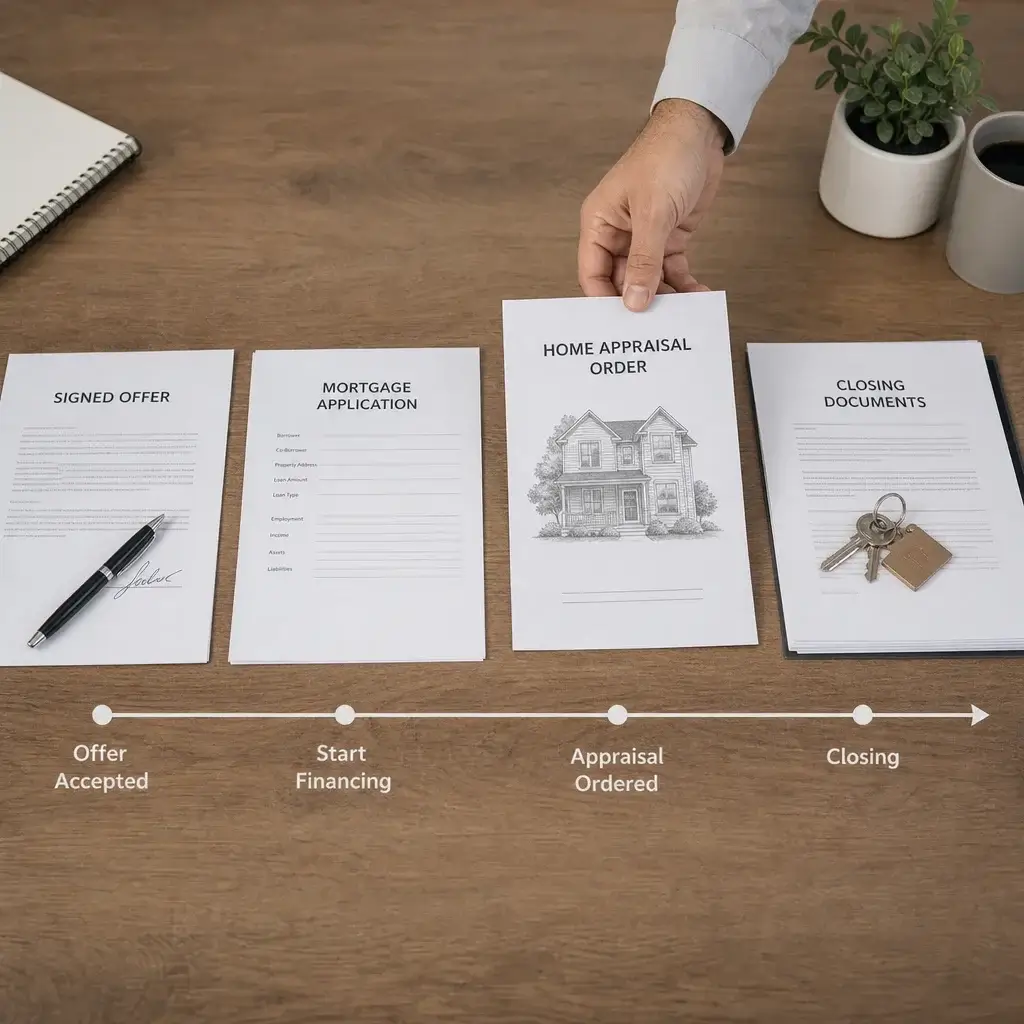
The appraisal stage of home buying usually happens after the offer is accepted and after the mortgage application and supporting documents are submitted to the lender. In most purchase files, the sequence is accepted offer, mortgage submission, lender review, appraisal ordered if needed, report reviewed, financing decision, mortgage instructions, then closing preparation.
The appraisal is commonly ordered during the financing-condition period, not before. A lender wants an actual signed deal, a property address, a price, and a live underwriting file before spending money on valuation.
Yes, an appraisal can be ordered before an offer is accepted in some situations, but it is less typical and often less useful. A pre-offer appraisal may help a cautious buyer on a unique property, but mainstream lenders usually want their own process and their own approved appraiser once there is a live purchase agreement.
The site visit itself is often short. For a standard condo or house, the appraiser may be at the property for about 20 minutes to 1 hour, and complex or larger properties can take longer. The report turnaround is commonly about 2–7 business days, with rush files sometimes faster and unique, rural, or thin-comparable properties taking 1–2 weeks.
What happens after appraisal when buying a house is straightforward in sequence, even if the result is stressful. The lender reviews the report, decides whether the value supports the loan, clears or adds conditions, then issues or updates mortgage instructions if the file proceeds.
Who orders the appraisal and who pays for it
In a mortgage purchase, the lender or mortgage broker on the lender’s platform usually orders the appraisal. Buyers usually cannot pick just any appraiser because lenders rely on approved channels and controlled ordering systems.
Yes, it is typical for the buyer to pay for the appraisal. On many Ontario purchase files, the borrower is charged the fee directly or indirectly through the mortgage process, although some lenders absorb the cost on certain products or promotions.
No, the buyer does not always pay in every file. Private lenders, credit unions, cashback products, and broker arrangements can handle the charge differently, but the safe assumption is that the cost lands with the borrower unless the lender says otherwise in writing.
How much a home appraisal costs in Canada and Ontario
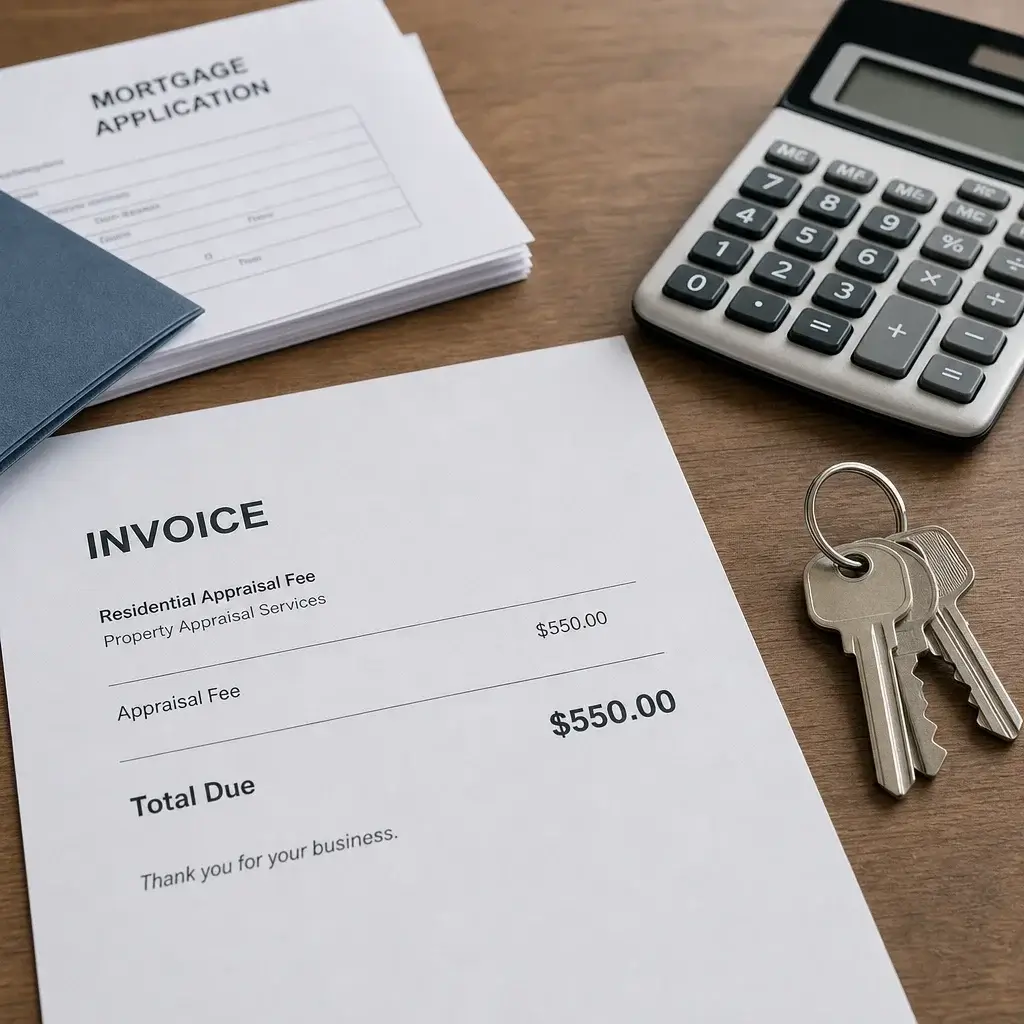
A standard residential appraisal in Ontario often costs about $300–$700, and more complex files can run higher. The number moves with property type, urgency, condo versus detached, urban versus rural location, access issues, and whether the lender wants a standard form, a rush report, or a more specialized valuation.
A simple Toronto condo usually sits at the lower end of that range, while a large detached home, a rural property, a mixed-use property, or anything with thin comparable sales can cost more. I tell buyers not to fight over this fee. Saving a few hundred dollars on valuation is not the place to cut corners on a six- or seven-figure purchase.
No, there is no single universal Ontario fee. Some quotes include HST and some add it, and the exact cost depends on who orders the report and what kind of property is being valued.
What appraisers look at and what affects value
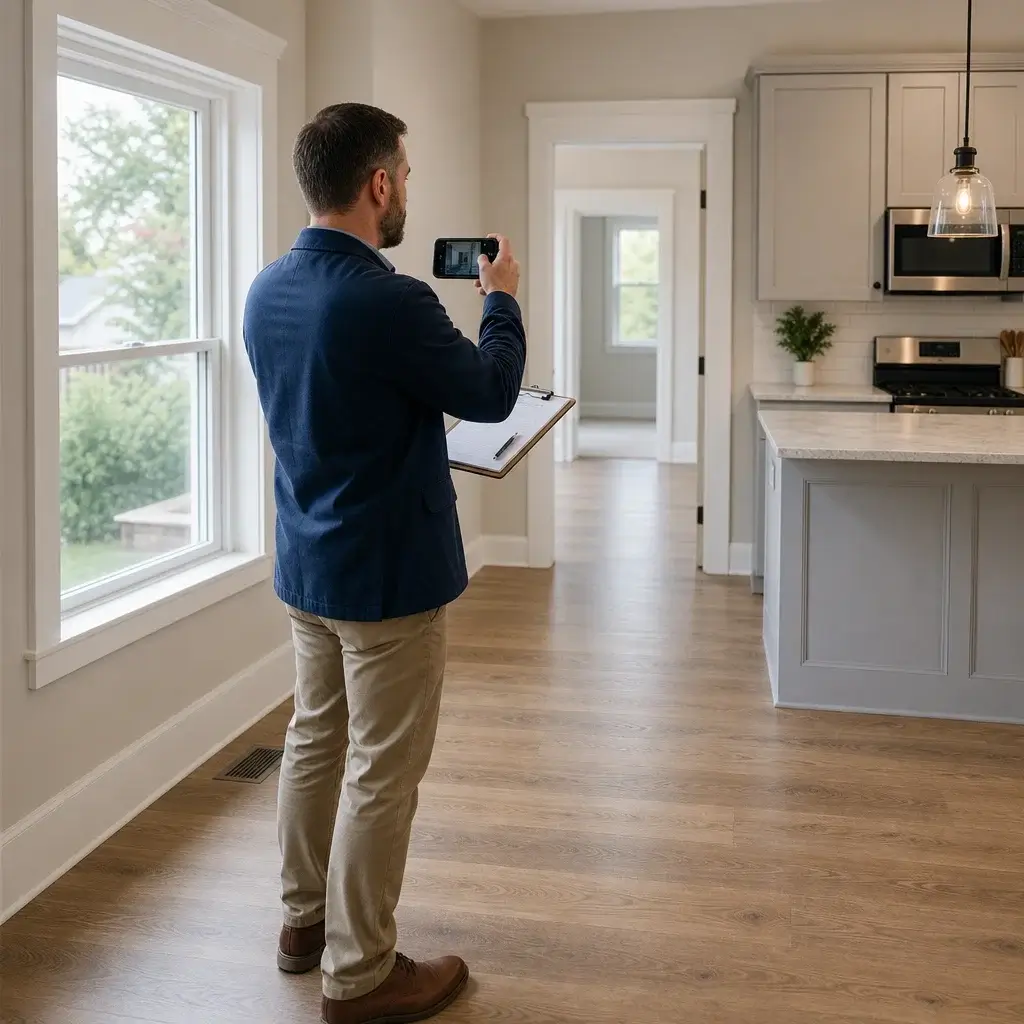
Appraisers look at the property itself, the neighbourhood, and comparable sales. They review size, layout, condition, age, renovations, parking, lot characteristics, legal use, and market evidence from recent sales that compete with the subject property.
For condos, the appraiser will usually consider the unit, the building, maintenance fees, amenities, parking, locker rights, and recent sales in the same building or similar nearby buildings. A parking spot in downtown Toronto can carry real value, and a missing locker or awkward layout can cut the other way.
For freeholds, deferred maintenance matters. Roof issues, water intrusion, dated systems, foundation concerns, unpermitted additions, and functional problems like a poor layout can drag value down. Thin comparable data also hurts because the report becomes less certain.
No, cosmetic staging does not fix structural or legal problems. Clean access helps the appraiser do the job, but what ruins an appraisal more often is poor condition, unpermitted work, external nuisances, unusual features with weak comps, or a purchase price that outran the local evidence.
A legal basement apartment can support value differently than an informal one. In Ontario, appraisers and lenders care whether the use is legal and supportable, not just whether a seller says the basement “could rent for” a certain amount.
Appraisal vs purchase price vs market value vs MPAC vs CMA
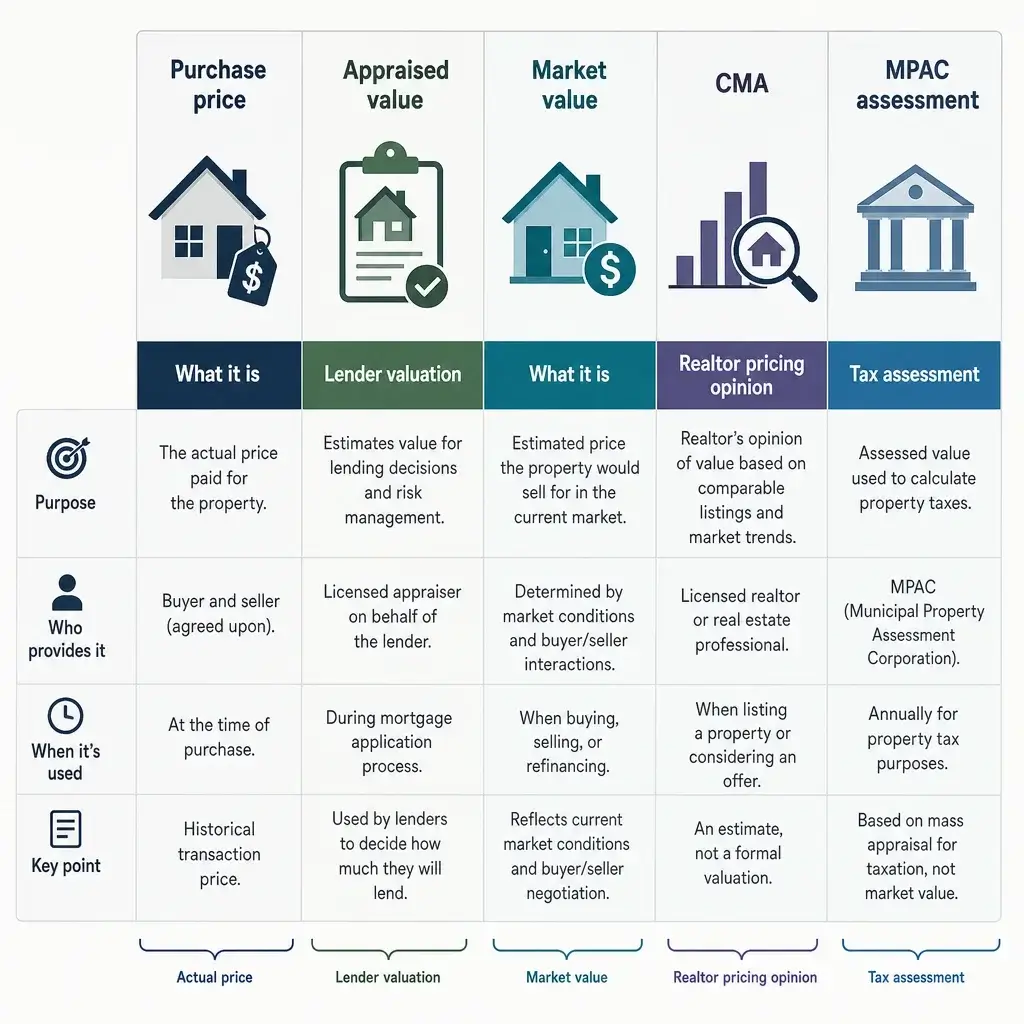
These terms are not the same, and mixing them up causes bad decisions.
| Measure | Who creates it | Why it exists | How it is used | Controls mortgage lending? |
|---|---|---|---|---|
| Purchase price | Buyer and seller | Agreed deal price | Sets the contract amount | No, not by itself |
| Appraised value | Appraiser for lender | Independent value opinion for lending security | Helps lender decide loan support | Yes, often directly |
| Market value | Valuation concept | Estimate of what the property would sell for in an open market | Broader valuation benchmark | Indirectly, through the appraisal |
| CMA | Realtor or broker | Pricing opinion using local sales | Listing and offer strategy | No |
| MPAC assessment | MPAC | Property assessment for tax purposes | Municipal taxation framework | No |
No, an appraisal is not the same as purchase price. The purchase price is what buyer and seller agreed to. The appraised value is the lender’s valuation evidence at that moment on that file.
No, a home appraisal same as purchase price is not something I would ever promise. Sometimes the numbers are close. Sometimes they match. Sometimes they do not, especially in bidding wars, unique properties, softer submarkets, or fast-changing segments.
Appraised value vs market value is a narrower distinction. Market value is the concept. The appraisal is the appraiser’s supported estimate of that concept for lending use.
No, MPAC does not tell your lender what the property is worth today. MPAC assessments are for property tax purposes in Ontario, and buyers should not use them as a stand-in for a lender appraisal.
How loan-to-value changes when the appraisal is lower than the purchase price
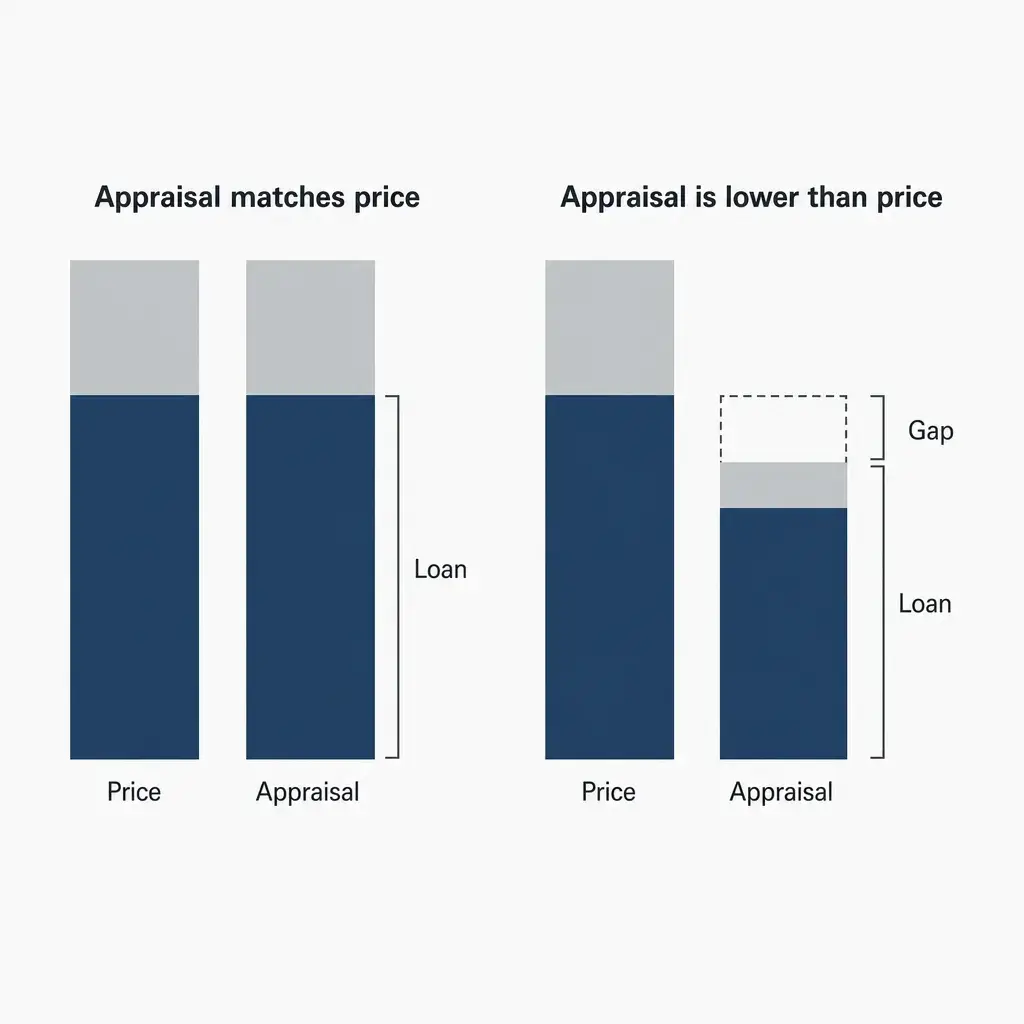
The lender’s math can change your down payment fast. If the purchase price is $600,000 and the appraisal also comes in at $600,000, an 80% loan would be $480,000 and the buyer’s down payment would be $120,000, before closing costs.
If the purchase price is $600,000 but the appraisal comes in at $580,000, an 80% loan on the appraised value is $464,000, not $480,000. The buyer still owes the seller $600,000 under the contract, so the extra $16,000 has to come from the buyer unless the price is renegotiated or another solution is found. That is the appraisal gap.
If the purchase price is $700,000 and the appraisal comes in at $725,000, the buyer does not usually get to borrow against the higher number automatically. In many purchase files, the lender still underwrites to the lower of price and appraised value, so the practical upside is comfort, not free extra loan proceeds.
The same issue hits smaller down payment files harder. A buyer who was already stretching to meet minimum equity requirements can find that even a $10,000–$25,000 shortfall kills the closing if there is no family gift, line of credit, or price reduction available.
What happens if the appraisal comes in lower than the purchase price

Yes, a low appraisal can reduce the mortgage amount or force the buyer to add cash. That is the immediate problem, and it has to be solved before closing, not argued about in theory.
Your main options are usually five. Renegotiate the price. Increase your cash to close. Ask the lender to review the appraisal. Try another lender if time allows. Terminate the deal only if the agreement and conditions actually give you that right.
No, a buyer cannot always walk away after a low appraisal. In Ontario, the legal answer depends on the Agreement of Purchase and Sale, whether there is an open financing condition, whether that condition was waived or fulfilled, and what efforts the buyer made to obtain financing.
I have seen buyer’s-remorse arguments dressed up as financing problems. They fail. If the real issue is a low value, you need to review the contract, the condition wording, the lender response, and the closing timeline quickly.
A $10,000 gap is usually easier to solve than a $50,000 gap. At the lower end, family funds, a price concession, or a lender change may save the file. At the higher end, the deal often depends on whether the seller will move and whether the buyer had a real financing escape route left.
Buyer decision tree: your options depend on the contract terms
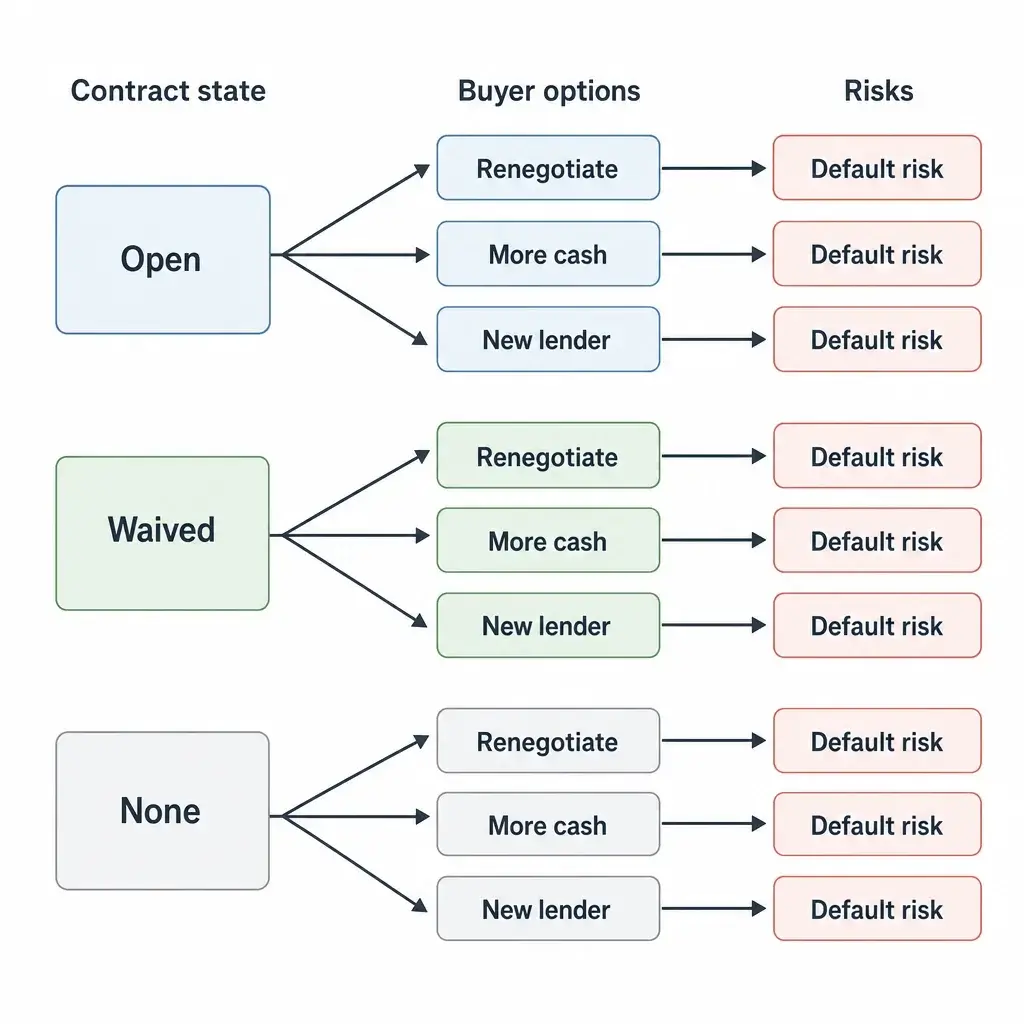
If the financing condition is still open, the buyer’s position is strongest. You should speak to the lender or broker first, then your real estate lawyer, then your realtor if a renegotiation is realistic.
If the financing condition has been waived or fulfilled, the risk jumps. The buyer may still try to renegotiate or replace financing, but the seller can usually insist on closing according to the contract unless another contractual right exists.
If there was no financing condition at all, the appraisal issue is usually now a funding problem, not a contract exit. That is where buyers get exposed to deposit loss, damages claims, and default risk if they cannot close.
If the buyer is paying cash and ordered an appraisal voluntarily, the report may help with negotiation, but it does not create a legal right to reopen the price unless the seller agrees or the contract says otherwise.
This is the practical decision tree I use on these files:
| Contract status | Buyer option | Main risk |
|---|---|---|
| Financing condition still open | Review lender response, decide whether condition can be satisfied, negotiate if needed | Missing the condition deadline |
| Financing condition waived/fulfilled | Find more cash, seek new lender, negotiate if seller willing | Default if funds are short |
| No financing condition | Funding scramble or negotiated amendment | Deposit loss and damages exposure |
| Cash buyer with voluntary appraisal | Try to renegotiate using report | Seller can refuse |
Can you challenge a low appraisal?
Yes, sometimes, but the lender controls the process. Buyers usually do not argue directly with the appraiser. The request typically goes back through the lender, broker, or appraisal management channel with supporting evidence.
The strongest challenge points are factual errors, missed comparable sales, omitted parking or locker rights, overlooked legal features, or documented renovations with permits and receipts. Disagreement alone is not enough.
A reconsideration can take a few business days, and sometimes longer if a second review is needed. That timing matters because a buyer with 3–5 days left before closing has fewer practical options than a buyer still inside a 5–10 business day financing window.
No, a challenge does not guarantee a new number. I have seen reports stand even when everyone on the deal disliked them. The issue is not whether the buyer thinks the house appraisal when buying was unfair. The issue is whether the lender will rely on different evidence in time.
What if the appraisal is higher than the purchase price?
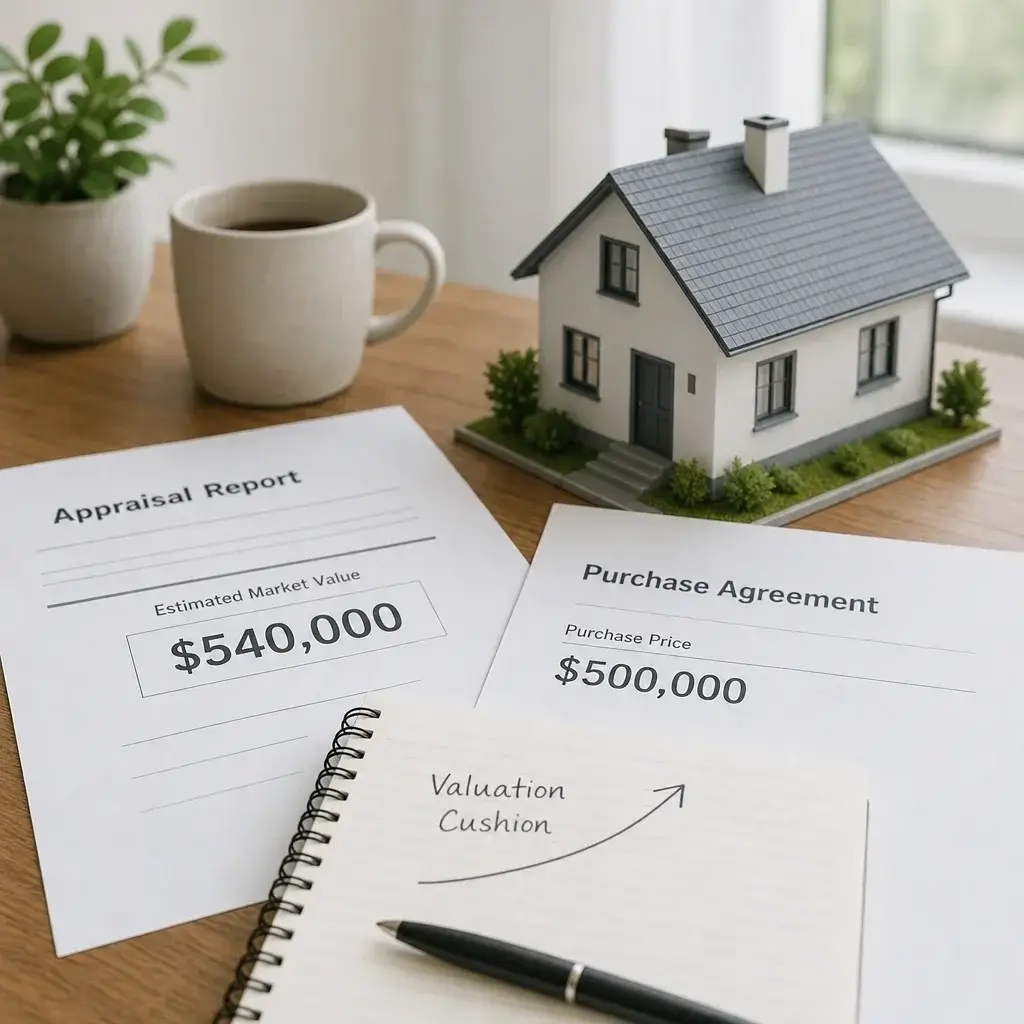
Yes, that is generally good news, but not as dramatic as buyers hope. It suggests the lender’s valuation support is at least as strong as the contract price, which can reduce concern that the buyer overpaid.
If the purchase price is $700,000 and the appraisal is $725,000, the buyer may have a paper cushion of $25,000. That is often described as instant equity, but it is not cash in hand and it does not automatically change the mortgage amount or rate.
No, a higher appraisal does not force the seller to lower the price further, and it usually does not mean the bank will lend more just because the number came in above the deal price. The contract price still governs what the buyer has agreed to pay.
What happens after the appraisal: mortgage approval, legal work, and closing
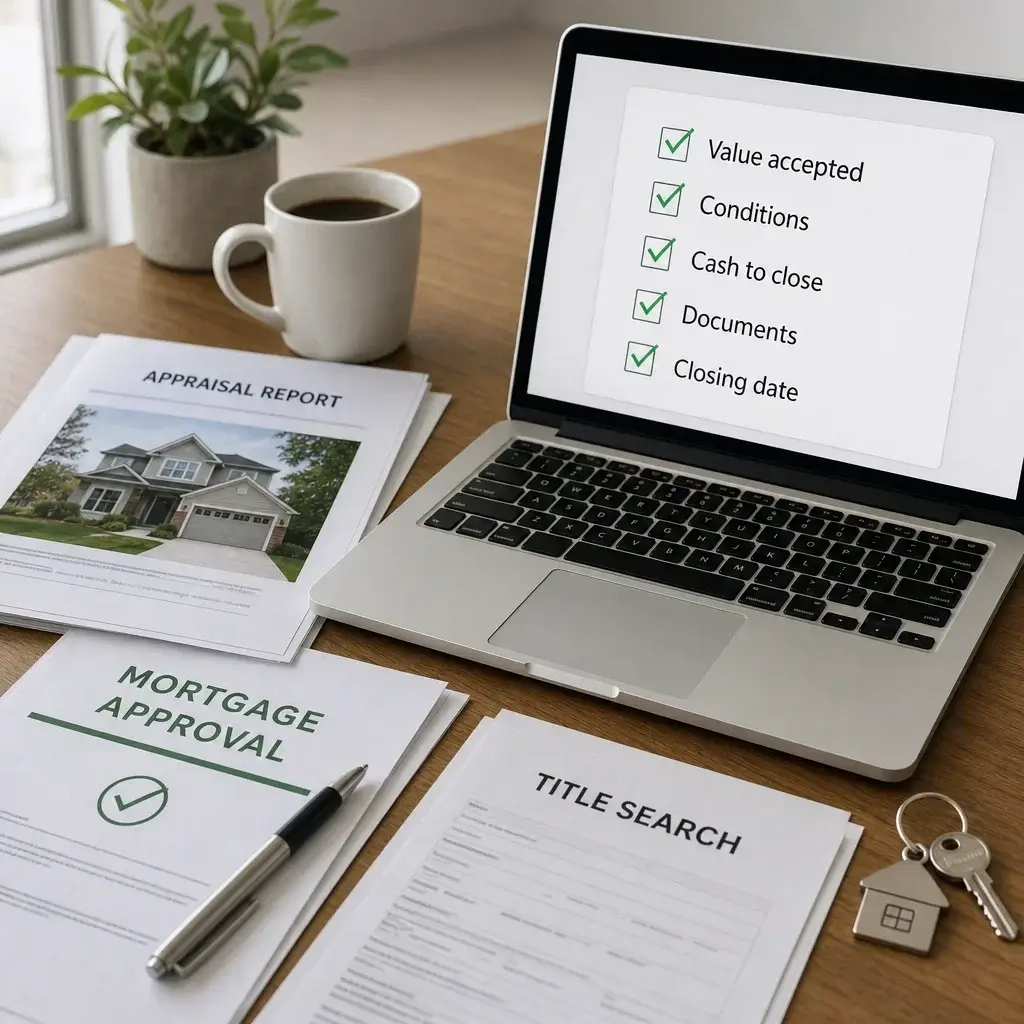
After the appraisal is done, the lender reviews it and decides whether the value supports the mortgage request. If the answer is yes, the file still has to clear the rest of underwriting, document review, and final conditions.
No, appraisal completion does not mean the loan is approved. Income verification, down payment sourcing, insurance, credit re-checks, outstanding lender conditions, and property-specific concerns can still delay or derail final approval.
Mortgage approval after appraisal often takes a few business days, and more complex files can take 1–2 weeks. The number moves with lender workload, missing documents, insurer involvement, and whether the appraisal created new questions.
Our legal work runs in parallel. We review title, search for encumbrances, review mortgage instructions, prepare closing documents, calculate adjustments, and coordinate funds. If financing wobbles late, the legal problem is not abstract. It becomes whether the buyer can still close on the date promised.
A practical after-appraisal checklist is short:
- confirm whether the lender accepted the value
- ask whether any financing conditions remain
- confirm your final cash to close
- send any outstanding documents fast
- tell your lawyer immediately if value or approval becomes an issue
- avoid new debt or account changes before closing
Does appraisal mean the loan is approved?
No, an appraisal alone does not equal final mortgage approval. It answers one lending question: does the property support the loan amount.
A mortgage can still be denied after appraisal if income cannot be verified, the down payment source is not acceptable, credit changes, the lender’s remaining conditions are not met, or the property raises other underwriting issues. That is why I tell buyers not to treat a booked appraisal as a green light to relax.
Most clean files close clean. Easily 8–9 in 10 standard residential files move from accepted value to closing without appraisal drama. The ugly ones usually involve time pressure, waived conditions, unusual properties, or buyers who assumed pre-approval meant final approval.
How to prepare for an appraisal as a buyer or seller

Preparation is factual, not theatrical. The best package is a short list of upgrades, renovation dates, permits if applicable, receipts for major work, survey if available, floor plans, and correct details about parking, locker, or legal rental status.
For sellers, access matters. Utilities should be on, key rooms should be accessible, and major features should be easy to inspect. Cleanliness helps presentation, but functioning systems and accurate information matter more.
For buyers, the real preparation starts before the report is ordered. Review comparable sales with your realtor before you sign too aggressively. A buyer who understands local evidence early is less likely to be shocked by a later appraisal during home purchase financing.
Yes, owners or agents sometimes walk through the property with the appraiser, but they should stick to factual information and not interfere. The right move is to provide documents and corrections, not a speech about what the property “needs to appraise at.”
What not to say to an appraiser
No, do not try to pressure the appraiser to hit your number. Saying you “need at least $900,000” or that the deal will die without it is the wrong approach and can backfire.
Do not hide defects or misstate square footage, permits, renovation quality, or legal status. If a basement unit is not legally established, saying it is a legal apartment anyway is not clever. It is a credibility problem.
The useful approach is simple: give factual, documented information. Provide upgrade lists, permit records, condo parking details, and anything material the appraiser may not see easily from a quick walkthrough.
Home appraisal vs home inspection
A home appraisal estimates value for lending purposes. A home inspection looks for physical defects, deferred maintenance, and repair risks for the buyer.
No, one does not replace the other. A lender appraisal can be brief and value-focused. A home inspection is buyer due diligence and is usually more detailed about systems, defects, and future repair issues.
Serious inspection problems can affect value indirectly. If the inspector finds structural movement, knob-and-tube wiring, active leaks, or unsafe conditions, the lender or appraiser may care. But the processes are still separate.
Special situations that complicate an appraisal buying a house in Ontario
Condos can be straightforward or messy. Buildings with scarce comparable sales, unusual maintenance fees, litigation history, or awkward parking and locker rights can slow things down and create value questions.
Rural properties and unique homes often take longer to value because comparable sales may be farther away in time, distance, or property type. That can push turnaround from a few business days toward 1–2 weeks.
New construction can create its own problems. The appraiser may be valuing plans, specs, builder upgrades, and a market that shifts before closing. I have also seen buyers underestimate builder adjustments and then get squeezed on both cash to close and appraisal support.
Mixed-use properties, estate sales, inherited homes, non-legal basement units, and unpermitted additions all attract more scrutiny. These are the files where earlier coordination between lender, broker, and lawyer matters most.
FAQ: quick answers buyers ask about appraisals
What is an appraisal when buying a house?
It is an independent opinion of value used mainly by the lender to assess mortgage risk and loan support.
Who pays for the home appraisal in Ontario?
Usually the buyer or borrower pays, although some lenders absorb the fee on selected products.
How much does a home appraisal cost in Canada?
Many standard residential appraisals fall around $300–$700, with higher costs for complex, rural, rush, or unusual properties.
When does the appraisal happen in the home-buying process?
Usually after the offer is accepted and after the mortgage application is submitted, during the financing stage.
Does an appraisal mean the mortgage is approved?
No. The lender still has to complete the rest of underwriting and clear all conditions.
What happens if the appraisal is lower than the purchase price?
The lender may reduce the mortgage amount, and the buyer may need more cash, a lower price, another lender, or a valid contractual exit.
Can I renegotiate if the appraisal comes in low?
Yes, you can ask. Whether the seller agrees is a business question, and whether you can refuse to close is a contract question.
Can I walk away if the appraisal is too low?
No, not automatically. Your rights depend on the Agreement of Purchase and Sale and any live financing condition.
Is the down payment based on purchase price or appraised value?
In many files, the lender underwrites using the lower of the purchase price and appraised value. That can increase the cash you need if the value comes in low.
What happens if the appraisal is higher than the purchase price?
Usually nothing changes in the contract. It is favourable evidence, but it does not usually force a lower price or a larger loan.
Is a home appraisal the same as a home inspection?
No. An appraisal is about value for lending. An inspection is about condition and defects for the buyer.
Does an appraisal affect property taxes in Ontario?
No, not directly. Property taxes are tied to municipal taxation and MPAC assessment processes, not your lender’s appraisal on a purchase file.
Are appraisals always required for a mortgage in Canada?
No. Some lenders waive a full appraisal on lower-risk files, but many purchases still require one.
How long is a home appraisal valid for?
Many lenders treat appraisals as time-sensitive for roughly 60–120 days, but lender policy varies and extensions are not automatic.
Do buyers get a copy of the appraisal report?
Sometimes, but not always. The lender controls the report, and borrower access depends on lender policy and how the appraisal was ordered.
This article is general information, not legal advice on your specific deal. If an appraisal issue is threatening financing or closing, the right next step is to review the agreement, condition dates, lender position, and closing exposure before you make promises you cannot keep.